Some links earn us a commission.
News
AI Use Among UK Businesses Has Doubled: What a New Government Survey Means for Small Firms
Desk research by Penelope Voss
31 October 2026

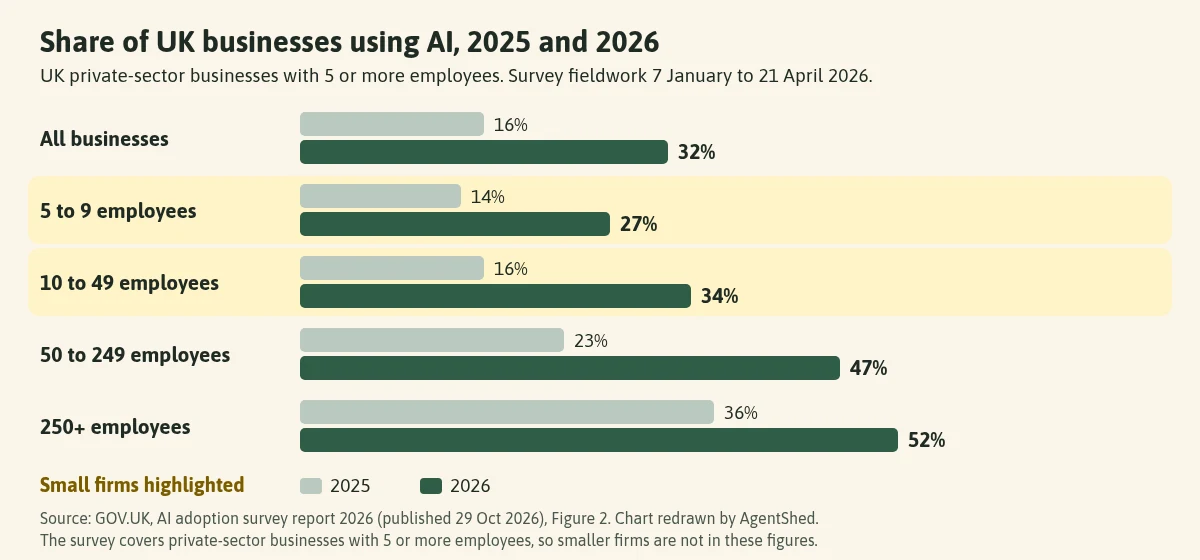
In short: A government survey published on 29 October found 32% of UK private-sector businesses with five or more employees were using AI in early 2026, up from 16% in 2025. Most use is text tools for admin. A sensible first step: one low-risk admin job on a free plan, every output checked.
The headline
On 29 October the UK government published its AI adoption survey 2026. It found that 32% of UK businesses with 5 or more employees were using at least one AI technology, up from 16% in the 2025 survey. The survey covers private-sector businesses.
Two things to know before you quote that number:
- The interviews were by telephone, with 3,503 businesses, between 7 January and 21 April 2026. It describes early 2026, not today.
- The survey covers private-sector businesses with 5 or more employees. Smaller firms aren't in these figures.
What businesses are actually doing
The full report is long. These are the figures most useful to a small business.
| What the survey found | Figure | What it suggests |
|---|---|---|
| Use by size, 2026 | 27% (5 to 9 employees), 34% (10 to 49), 52% (250+) | Use roughly doubled for all but the largest firms, which are still ahead |
| Language-model tools, among firms using or planning to use AI | 77% | Text-based tools are the most common kind of AI in use |
| Where AI is used, among firms using or planning to use it | Administration 81%, marketing 71%, IT 66% | Admin is the usual starting point |
| Models named, among AI adopters | OpenAI models 92%, Google 38%, Anthropic 14%, Mistral 2% | The figures add up to more than 100%, so many firms use more than one |
| Spend on AI in 2025, among firms able to estimate it | 47% reported £0 (52% of firms with 5 to 9 employees) | The report links this to free tools and AI built into existing software |
| Human checking of AI output, among businesses using AI | 81% apply some human input or checking (84% in 2025); 5% apply none (2% in 2025) | Most firms keep a person in the loop, slightly fewer than a year earlier |
Businesses interviewed for the report named ChatGPT, Copilot and Gemini among the tools they use. Our pages on ChatGPT, Gemini and Claude cover what each is and how it's priced.
The gains are modest
The report is careful not to oversell. Half of adopters (50%) reported an overall increase in productivity, but it describes those gains as generally modest. Among businesses using AI, 24% reported a reduction in operating costs, 64% saw no impact and 9% reported an increase. Among businesses using AI, only 14% rated the tools as of high importance to their operations (8 to 10 on an 11-point scale).
In its words, AI was "functioning primarily as a support tool, augmenting existing activities rather than redefining business models".
A second measure
The Office for National Statistics asks a different question of a different sample, in a voluntary survey of businesses of all sizes. For September 2026 it reports that 30% of all businesses used at least one AI technology, and 29% of businesses with fewer than 10 employees. It calls these official statistics in development and advises caution.
The two surveys don't line up exactly, and they shouldn't be added together. They do point the same way: use is rising, and smaller firms are behind larger ones.
What's holding firms back
- Skills and know-how. Limited AI skills, expertise or knowledge was a barrier for 67% of businesses that had adopted AI, and 78% of those planning to.
- Accuracy. 56% of adopters, and 60% of planners, had concerns about bias and lack of accuracy.
- Time more than tool prices. The report says cost was more often about the time, effort and resource needed to embed AI than the price of the tools.
A separate survey by the company Pax8, reported by IT Brief, asked 1,150 small business leaders across four countries, 350 of them in the UK. Of UK businesses that had paid for AI in the past year, 39% said at least one bill or usage charge was higher than expected. That's a company's survey, so treat it as a pointer, not a benchmark.
Where this may be heading
These are the survey's own findings on plans, not predictions:
- 65% of firms using or planning to use AI, among those able to estimate, expected their AI budgets to rise over time. That's down from 71% in the 2025 survey, so expectations have fallen.
- 31% expected more than half of their staff to be using AI within one to two years. 22% said that was already true.
- Planned investment over the next 12 months was mostly in off-the-shelf applications (61%), automating tasks previously done by people, but not whole jobs (57%), and embedding AI in existing tools or systems (54%).
- More advanced "agentic" AI was less widely trusted and more likely to be scrutinised.
Get the next guide by email. One email when we publish a new AI workflow. Join the AgentShed newsletter.
A first step this week
You don't need to match anyone else's number. A simple way to begin:
- Pick one admin job. Our 20-minute weekly admin audit helps you choose. Or start from a playbook such as Gmail triage with ChatGPT or customer FAQ replies.
- Use a free plan. ChatGPT, Gemini or Claude. Plans and limits change, so read the plan page before you rely on one.
- Practise with made-up text. Keep names, card numbers and private details out while you learn.
- Set one rule. A person reads every output before it goes anywhere.
- Review after a week. Keep it, change it or drop it.
If you want training, the AI Skills Hub FAQ says: "Many of our resources and courses are free to access, while some specialised programs may require a fee." Read the Skills Hub FAQ for what that covers.
If a job works by hand and repeats every week, that's when an automation tool may be worth a look. If you do get that far, Make is one we cover: its tool page explains its free plan and the catch with credits. Get it working by hand first.
How we made this
AI-assisted, and fact-checked against the GOV.UK executive summary and full report, the ONS bulletin, the IT Brief report and the AI Skills Hub FAQ, on 31 October 2026. We didn't run these surveys. The chart is redrawn from the report's Figure 2. The Pax8 figures are from a news report of a company survey. We haven't tested any tool for this article. See how we research a playbook.
FAQ
Does the survey include very small firms? No. It covers private-sector businesses with 5 or more employees. The ONS figure for businesses with fewer than 10 employees is 29% for September 2026.
Is 32% high or low? It's what the survey found, and double the 2025 figure. 38% of businesses said AI wasn't relevant to them, down from 51% in 2025.
Do I have to pay for AI? Many don't. Of firms able to estimate their spend, 47% reported spending nothing on AI in 2025.
Should I put customer details into an AI tool? Practise with made-up text first. Read each tool's data settings and terms yourself before you use real information.
Your next step
Choose one repeat admin job, try it on a free plan with made-up text, and check every result before it goes out. See where it helps, then decide what's next.
Sources (all read 31 October 2026): GOV.UK, AI adoption survey 2026 · GOV.UK full report (PDF) · ONS, Business insights and impact on the UK economy, 8 October 2026 · IT Brief, Pax8 survey · AI Skills Hub FAQ
Sources
- GOV.UK: AI adoption survey report 2026, executive summary (published 29 Oct 2026) — accessed 31 October 2026
- GOV.UK: AI adoption survey 2026, full research report (PDF, 116 pages) — accessed 31 October 2026
- Office for National Statistics: Business insights and impact on the UK economy, 8 October 2026 — accessed 31 October 2026
- IT Brief: UK small firms race to build AI tools without oversight (Pax8 survey, 26 Oct 2026) — accessed 31 October 2026
- AI Skills Hub: FAQ — accessed 31 October 2026
Related playbooks
Related tools
More from the blog
News
Mistral Just Released a Trillion-Parameter Open Model: What Open Weights Mean for Small Businesses
Mistral released the weights of Mistral Large 4. What open weights mean, what the licence says, and why most small firms will only meet it indirectly.
30 October 2026
Guide
Write Email Replies Faster With AI: A Simple Reply Kit for Small Businesses
Build a reply kit once: a facts sheet, two sample replies and three rules, so a free AI chat drafts emails in your voice. Practice data only, you send.
30 October 2026
News
Small AI Models Are Moving Onto Your Own Computer: What It Could Mean for Small Businesses
Liquid AI and Opera both shipped AI that runs on your own device this week. What that could mean for a small business, and what to do now.
29 October 2026