Some links earn us a commission.
Guide
AI Agent vs Chatbot vs Automation: What's the Difference for a Small Business?
Desk research by Penelope Voss
11 November 2026

In short: Ask who picks the next step. In automation, you do, in advance. A chatbot answers questions from content you give it. An AI agent chooses its own steps and tools to reach a goal you set. Most small business jobs need only automation or a chatbot, and an agent should wait for your approval before it acts.
What's the difference between an AI agent, a chatbot and automation?
An AI agent picks its own next step, a chatbot answers from a script or knowledge base, and automation follows fixed steps you set. Ask one more question: who picks the next step?
- Automation: you do, in advance. The tool follows your rule: when this happens, do that.
- Chatbot: the person chatting picks. It answers questions from the content you give it.
- AI agent: an AI model picks. You give it a goal, and it chooses the steps and tools to get there.
Plenty of products blur these. A chat widget can trigger an automation. An agent can run inside an automation tool. But the question still sorts them, and it tells you how much to trust each one.
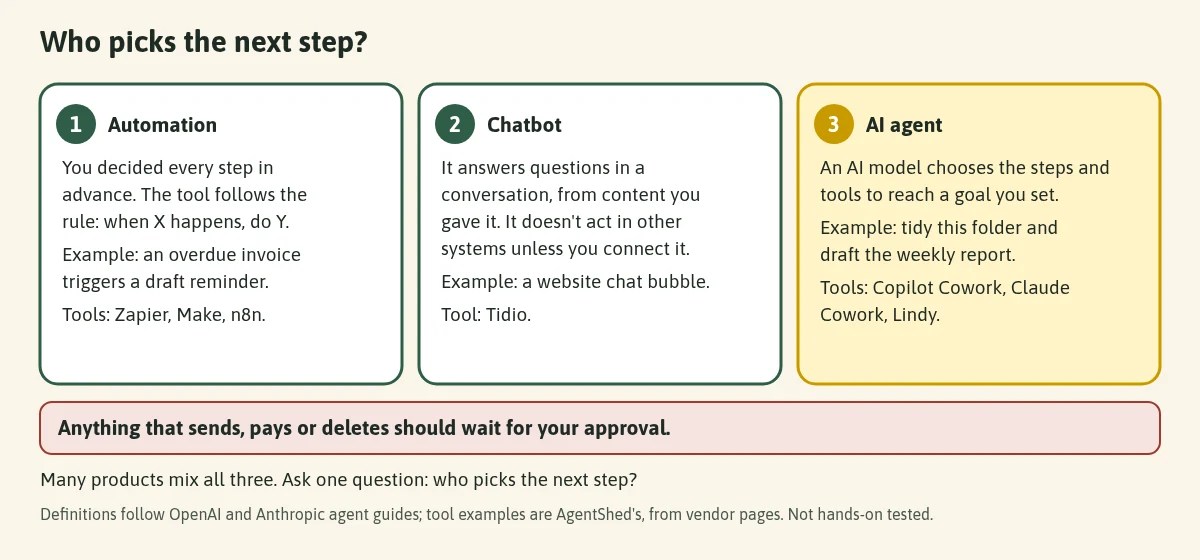
| Automation | Chatbot | AI agent | |
|---|---|---|---|
| Who picks the next step | You, in advance | The person chatting | An AI model |
| Typical small business job | Overdue invoice triggers a draft reminder | Website visitor asks your opening hours | "Tidy this folder and draft the weekly report" |
| Predictable? | Yes, if the rule is right | Mostly, if your page is right | Less so |
| Example tools | Zapier, Make, n8n | Tidio | Copilot Cowork, Claude Cowork, Lindy |
This is AgentShed's framing, and we haven't hands-on tested these tools. The examples come from the vendors' own pages.
What do OpenAI and Anthropic mean by "agent"?
OpenAI and Anthropic both describe an agent as a system where the model chooses what to do next, not only what to say. "Agent" gets stretched to cover almost anything, so their own wording helps.
OpenAI's guide says: "Agents are systems that independently accomplish tasks on your behalf." It adds that "Applications that integrate LLMs but don't use them to control workflow execution—think simple chatbots, single-turn LLMs, or sentiment classifiers—are not agents." On that definition, a chatbot that only answers questions isn't an agent.
Anthropic draws the line differently, between two kinds of system: "Workflows are systems where LLMs and tools are orchestrated through predefined code paths. Agents, on the other hand, are systems where LLMs dynamically direct their own processes and tool usage, maintaining control over how they accomplish tasks."
The two definitions land in the same place. If a person or a fixed rule decides the path, it's not an agent. If the AI decides the path, it is. Anthropic also says "Agentic systems often trade latency and cost for better task performance", and that "The autonomous nature of agents means higher costs, and the potential for compounding errors." That is the vendor's own warning, and it's why we'd start with the simpler options.
When is plain automation the better choice?
When the steps never change, use automation. Chasing an overdue invoice, copying an enquiry into a sheet, or sending a Monday digest are fixed sequences. An AI model can help with the wording, but you don't need one choosing the steps.
Anthropic's advice to its own developers applies to you too: "we recommend finding the simplest solution possible, and only increasing complexity when needed. This might mean not building agentic systems at all."
Even a vendor that sells agents says this. Make's AI Agents page says: "If it just needs doing, use automation. If it needs thinking, use Make AI Agents." That's Make's marketing line, but the first half is good advice.
What the tools list, as we read them:
- Zapier: the free plan is listed as "Two-step Zaps" with "100 tasks per month" (read 2 November 2026). Our lead capture playbook fits inside that. See our Zapier page.
- Make: its pricing page, read on 1 November 2026, listed a free plan counted in credits, not runs. Our invoice chasing playbook creates drafts you send yourself, and our Make page has the detail.
- n8n: n8n's pricing page lists "A standard, self-hosted version of n8n" on GitHub, as well as paid Cloud plans. Self-hosting is a second job. Our weekly digest playbook and n8n page say more.
If you're not sure which jobs are worth automating, our 20-minute weekly admin audit starts with a list.
When does a chatbot fit?
When customers ask the same questions and you can write the answers down. A chatbot is only as good as the page behind it. If your prices and rules aren't written down yet, it will guess.
Tidio is one example. Its pricing page, read on 2 November 2026, lists a Free plan at $0 and a 7-day free trial on paid plans. Check the live page for the AI allowance, because it varies by plan. Our Tidio page and website support chat playbook put the order of work as: write the answers, test with awkward questions, then switch it on. We haven't hands-on tested Tidio.
Keep a human in the loop for money, safety and complaints. A chatbot that hands over when it doesn't know is a good one.
When is an AI agent worth it?
When the job needs judgment and the steps can't be listed in advance, and a mistake is cheap to catch. Think of a messy folder, a pile of unstructured emails, or a report that pulls from several places. Those are what agents are marketed for.
What the vendors say about the agents on our tool pages:
- Copilot Cowork: Microsoft's UK page, as summarised on our Copilot Cowork page, says it plans multi-step tasks and pauses before sensitive steps such as sending an email. It's metered on top of a licence.
- Claude Cowork: Anthropic describes it as multi-step work in files and tools you choose. Our Claude Cowork page says it needs a paid Claude plan.
- Lindy: its pricing page, read on 1 November 2026, says "Anything with outside impact waits for approval such as sending an email".
Notice what they have in common: approvals. An agent that drafts and waits is much safer than one that sends. Whether a vendor's approvals work as described is something we haven't tested, so run your own made-up test first.
Agents can also cost more to run, which is Anthropic's point above. Copilot Cowork, which our tool page lists as metered on top of a licence, is one example of agent work billed by use. Check the vendor's live page before you commit.
Which should I try first?
Try plain automation first, then a chatbot for repeat customer questions, and only then an agent for messy judgment work. Our suggestion, not tested advice:
- Start with automation if you can write the steps on one sheet of paper. It's the cheapest and most predictable.
- Add a chatbot if the pain is repeat customer questions on your website, and your answers are written.
- Try an agent last, on a made-up task with made-up data, with approvals on. If you can't say what a bad result would look like, you're not ready to trust one.
Free tiers are enough to learn the difference. ChatGPT has a free plan with limits, which is enough to draft a rule or a FAQ page before you build anything.
How do I keep an AI agent from doing something I didn't want?
Keep an AI agent from overreaching by limiting what it can touch, requiring a human for money and complaints, and logging what it did. Five rules, ours, borrowed from the vendors' own cautions:
- Approvals on for anything that sends, pays or deletes.
- Give it the least access you can. One folder, not your whole drive.
- Test with made-up data. Fake customers, fake invoices.
- Set a spending limit if it's metered, before anyone uses it.
- Read the log. If you can't see what it did, don't give it real work.
Get the next guide by email. One email when we publish a new AI workflow. Join the AgentShed newsletter.
How we made this
AI-assisted, and checked against the OpenAI and Anthropic guides and each vendor's own page, linked below, on 1 and 2 November 2026. Quotes come from those pages, vendor claims are attributed to the vendor, and the framing is our own. We haven't hands-on tested any tool here, so this isn't a ranking, and prices change: check the live page. See how we research a playbook.
FAQ
Is a chatbot an AI agent? By OpenAI's definition, a simple chatbot is not an agent, because the model doesn't control the workflow. Marketing often uses the words loosely, so check what the product does.
Is automation the same as AI? No. Automation follows rules you set, and may or may not use AI. In Anthropic's terms, a fixed path is a workflow, not an agent.
Do I need an AI agent for my small business? Often not. Anthropic itself advises "finding the simplest solution possible" and notes this "might mean not building agentic systems at all." Try automation or a chatbot first.
Are AI agents safe to use with customer data? That depends on the product and what you connect. Start with made-up data, give access to one folder or inbox only, and keep approvals on. Check each vendor's data terms.
What's the cheapest way to try this? Free plans: Zapier lists a free two-step plan, Tidio lists a Free plan, and n8n can be self-hosted. Check each live page.
Your next step
Pick one repeat job. Write its steps on one sheet of paper. If the steps never change, that's automation. If they depend on judgment, that's a job to try an agent on later, with approvals on.
Sources (read 1 and 2 November 2026): OpenAI, A practical guide to building agents · Anthropic, Building effective agents · Make AI Agents · Make pricing · Zapier pricing · n8n pricing · Tidio pricing · Lindy pricing
Sources
- OpenAI: A practical guide to building agents — accessed 2 November 2026
- Anthropic: Building effective agents — accessed 2 November 2026
- Make: AI Agents (affiliate link) — accessed 2 November 2026
- Make pricing (affiliate link) — accessed 1 November 2026
- Zapier pricing — accessed 2 November 2026
- n8n pricing — accessed 2 November 2026
- Tidio pricing — accessed 2 November 2026
- Lindy pricing — accessed 1 November 2026
Related playbooks
Related tools
More from the blog
Tools
Free AI Tools for Small Businesses: 10 to Try, and Where Each Free Plan Runs Out
Ten free or free-to-try AI tools for small businesses, grouped by job, with what each free plan lists and where it stops. Pricing pages read on 1 November 2026.
7 November 2026
Tools
Best AI Automations for Small Businesses: 10 to Set Up on Free Plans
Ten AI automations a small business can set up on free plans, from website chat to invoice chasing, with the tool for each and where its free plan stops.
12 November 2026
News
Microsoft Copilot Business Pricing in the UK: What the Licence Costs and What Copilot Credits Add
Microsoft's UK price for Copilot Business, how metered Copilot Credits sit on top, and the 1 December date it gives for default-on billing.
10 November 2026