Some links earn us a commission.
Tools
Free AI Tools for Small Businesses: 10 to Try, and Where Each Free Plan Runs Out
Desk research by Penelope Voss
7 November 2026

In short: Free AI plans are samples, not a business plan. Start with one general assistant (ChatGPT, Claude or Gemini), add Fathom if you take calls, and leave automation tools until you have a repeating job to automate. We list ten, grouped by job, with the limit each vendor's own pricing page shows.
The short version
Most "free AI tools" lists are a pile of logos. This one is grouped by the job you want done, and for each tool it says what the vendor's own pricing page lists on the free plan and where that plan stops. We read every page on 1 November 2026.
Our view, up front: a free plan is a sample, not a business plan. Use it to find out whether a tool fits a real chore in your week. Don't build anything customers depend on until you've read the limits below. And don't try ten tools. Pick one general assistant, add one specialist for your most annoying chore, and stop there.
How we picked: tools that list a free plan, a free allowance or a free trial on their pricing page, that suit common small business jobs, and that we already cover on AgentShed. They aren't ranked, and we haven't hands-on tested all of them. Our tool pages say so plainly where that's the case. "Free" also means different things here, so we've said which kind each is.
Your all-purpose assistant (pick one)
1. ChatGPT
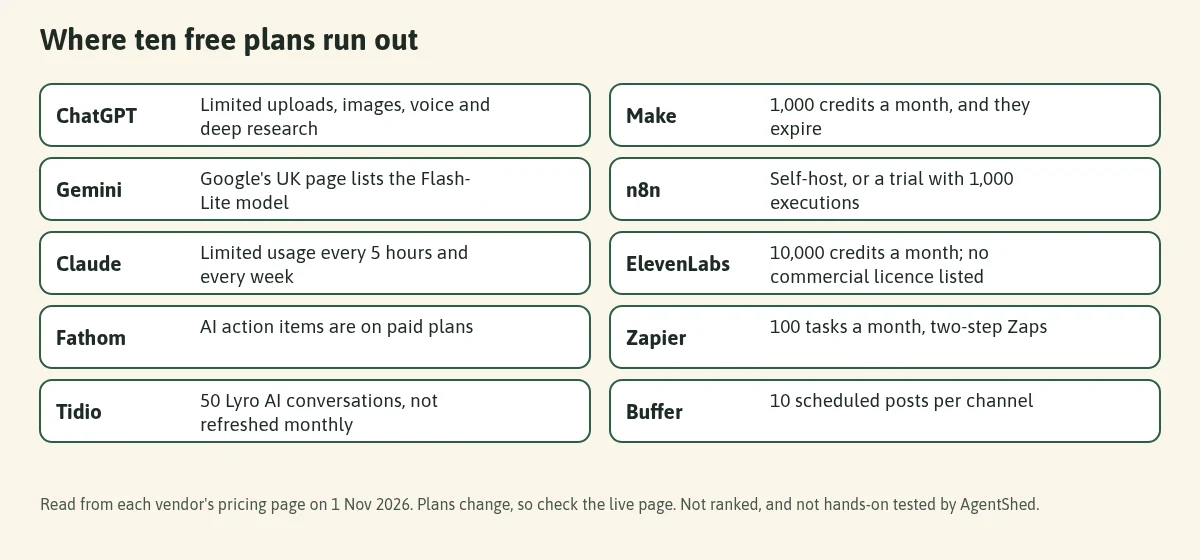
Free means: a permanent free plan. OpenAI's pricing page lists "Unlimited text chats with GPT-6" (with a footnote that usage must be reasonable) and limited messages with uploads, limited image creation, limited voice chats and limited deep research.
Where it stops: Projects are listed as available on Free, but uploads, images, voice and deep research are capped, and scheduled tasks are listed as "No". Note OpenAI's help page also says that "Starting in December, Plus, Pro, and Business plans' usage allowance will be shared across ChatGPT and Codex", measured in tokens. It names those paid plans, not Free, so check Settings → Usage before you rely on any plan.
Our view: the easiest place to start if you've never used AI. Our customer FAQ replies playbook uses it to turn one written FAQ page into drafted replies, with you pressing send. See also our ChatGPT page.
2. Claude
Free means: a permanent free plan, listed with "Limited usage every 5 hours and every week", web, desktop and mobile chat, web search, file creation, memory and connectors.
Where it stops: usage. Anthropic's page says "How fast you reach a limit depends on the model you use, how long your chats are, and how large your files are." Projects are listed as "Up to 5" on Free. Research, Claude Code and scheduled tasks are listed under paid plans.
Our view: a good second opinion on longer writing and documents. Give it a fair trial on a real report or policy page, and watch how quickly the limit arrives. See our Claude page.
3. Gemini
Free means: a permanent free plan. On the UK version of Google's subscriptions page, Free (£0 a month with a Google Account) lists access to "our Flash-Lite model", image generation and editing, Deep Research, Gemini Live, Canvas and Gems, plus 15 GB of cloud storage across Gmail, Drive and Photos.
Where it stops: that's the UK version of the page, as served to us. Google shows different versions by country, so open your own. "Gemini in Gmail, Vids and more" is listed under the paid Google AI Plus plan (£4.49 a month on that page), and "Gemini in Gmail, Docs, Vids and more" under Google AI Pro, not under Free.
Our view: worth a look if your business already lives in Gmail and Google Drive. Judge it by what you'll actually have switched on, not by the paid plans' feature lists. See our Gemini page.
Which of the three? Pick one for a month. If you can't decide, pick the one whose app you already have signed in.
Calls and meetings
4. Fathom
Free means: a permanent free plan for individuals. Fathom lists "Unlimited recordings + transcriptions", "Choice of bot-free (in beta) or bot capture" and "Instant AI call summaries".
Where it stops: "Advanced call summaries" and "AI-generated action items" are listed under the paid Premium plan. On that page, the free summary covers what was said, and the action-item list is the paid part.
Our view: if you take client calls and forget what you promised, a free note-taker is a low-risk thing to try. Tell people you're recording. Recording calls can raise consent and data protection questions, and the rules depend on your country and who is on the call. This is general information, not legal advice, so check what applies to you. Our meeting notes to tasks playbook shows the routine with made-up examples, and our Fathom page has the detail.
Customers and enquiries
5. Tidio
Free means: a free plan plus a starting allowance. Tidio's pricing page says "Every Tidio account starts with 50 Lyro conversations, but you need to upgrade to the Lyro AI Agent plan to refresh it monthly." Its free Customer Service plan limits Flows (automated chat paths) to 100 unique visitors a month, and it offers a 7-day trial of all features without a card.
Where it stops: the 50 AI conversations are a one-off allowance, not a monthly refill. Tidio says Lyro "draws on your support content". Tidio also says its customers "average a 75% resolution rate with Lyro", which is Tidio's own claim and not something we've checked.
Our view: treat the free allowance as a trial of whether your own FAQ page is good enough, not as a support desk. Write the answers first. Our website support chat playbook shows the order, and our Tidio page says plainly that we haven't hands-on tested it. If your customers find you on Google Maps, you may also want to read our news piece on Google's AI messaging pilot.
Automation (try these last)
6. Make
Free means: a permanent free plan with 1,000 credits a month. Make's pricing page (read 1 November 2026) says most actions use 1 credit, and "Credits expire at the end of the term."
Where it stops: when credits run out. Make's page says "Your scenarios won't continue to run, until credits are added again." The free plan's data storage equals one data store (1 MB).
Our view: you'll understand quickly whether you need it. If each step uses 1 credit, a three-step job that runs once a day uses about 90 credits a month, so a few small automations fit. A busy one won't. Our invoice chasing playbook walks through one, and our Make page covers the free plan.
7. n8n
Free means: two different things, and it matters which. n8n lists a self-hosted Community Edition ("A standard, self-hosted version of n8n is available on GitHub") and a free trial of n8n Cloud, with trial limits including "1,000 executions". Hosted plans start with Starter at "20€/mo, billed annually".
Where it stops: self-hosting means you run the server, the updates and the backups. The trial ends. We don't interpret licences, so read n8n's own licence and terms before using it commercially.
Our view: pick n8n over Make only if someone in your business is comfortable running software, or you want the hosted Starter plan. For most small businesses, Make or Zapier is the gentler first step. Our weekly admin digest playbook shows what a first workflow looks like, and our n8n page has the detail.
8. Zapier
Free means: a permanent free plan: "100 tasks/mo", unlimited Zaps, two-step Zaps and Zapier Copilot, which the page marks with an asterisk and lists with a daily message limit (the paid plans show "Unlimited").
Where it stops: two-step Zaps means one trigger and one action. Multi-step Zaps and webhooks are listed as features of the paid Professional plan and above, and the free plan's polling time is listed as 15 minutes. Check the comparison table for anything else you need.
Our view: a fair way to find out whether "when X happens, do Y" saves you anything, as long as Y is one step. Our lead capture playbook is built around that limit. See our Zapier page.
Voice and social
9. ElevenLabs
Free means: a permanent free plan with "10k credits per month" across text to speech, speech to text, sound effects and more.
Where it stops: ElevenLabs' page says that on its highest-quality models 1 character costs 1 credit, and 0.5 credits on its Flash and Turbo models. On the highest-quality models, 10,000 credits is therefore about 10,000 characters of generated speech. A "Commercial License" is listed as an addition from the Starter plan ($6 a month, with an introductory first-month offer shown on the page when we read it). The Free plan card doesn't list one. Rollover of unused credits doesn't apply to Free.
Our view: fine for trying a voice on a short script. If the audio is going on an advert, check the licence line for your plan first. Our ElevenLabs page and our guide to AI voices for small businesses cover the practical side.
10. Buffer
Free means: a permanent free plan with "10 scheduled posts per channel", 100 ideas, one user, an AI Assistant and 30-day insights.
Where it stops: the FAQ says the free plan has a three-channel limit, and each paid plan is priced per channel. Hashtag manager, first-comment scheduling and reports are listed as not included on Free. "AI replies" are limited to 5 suggestions a week.
Our view: if one person posts to a couple of channels, Free is enough to build the habit of batching a week's posts. Our social scheduler playbook shows how, and our Buffer page has the detail.
What should you check before relying on a free plan?
- Is it free forever, or free for a while? n8n's trial, Tidio's one-off allowance and Buffer's paid-plan trial are all different from a permanent free plan.
- What stops when you hit the limit? Make's scenarios stop. A chatbot that stops answering is worse than none.
- Can you use the output commercially? ElevenLabs lists a licence from Starter. Read the terms for each tool. We don't interpret them.
- What happens to customer data? Don't paste real customer details into a tool until you've read its data settings and tried it with made-up practice data.
- Is the page I'm reading the page for my country? The Gemini page we read was the UK version and showed pounds, while Zapier, Fathom and others showed US dollars. Plans, prices and countries differ, and plans change.
Get the next guide by email. One email when we publish a new AI workflow. Join the AgentShed newsletter.
How we made this
AI-assisted, and checked against each vendor's own pricing or help page, linked below, on 1 November 2026. The quotes come from those pages. We haven't hands-on tested all ten tools, and this list isn't ranked by testing. Our views are our own suggestions, and prices and limits change, so check the live page before you sign up. See how we research a playbook.
FAQ
Is there a really free AI assistant for a small business? ChatGPT, Claude and Gemini each list a permanent free plan with limits, on the pages we read on 1 November 2026. The limits differ, so try them with the same real task.
Which free AI tool should I try first? One general assistant. Then a meeting note-taker if you take calls, or a social scheduler if you post often.
Do free plans let me use the output in my business? It varies and we can't tell you. ElevenLabs lists a commercial licence from its Starter plan. Read the terms of each tool you use.
Will ChatGPT's usage change in December affect me? OpenAI's help page says the shared ChatGPT and Codex allowance applies to Plus, Pro and Business plans. It doesn't mention Free. Check Settings → Usage.
Should I start with an automation tool? Only when you have a task that repeats and a clear step-by-step routine. Automating a mess gives you a faster mess.
Your next step
Pick one chore from this week that you'd happily never do again. Match it to one tool above, open its pricing page, and check what stops when the free allowance runs out.
Free is also arriving from another direction: models you can run yourself. Our notes on small AI models on your own laptop and open-weights models explain what that could mean, and why most small firms will only meet it indirectly.
Sources (all read 1 November 2026): ChatGPT pricing · OpenAI, usage limits · Claude pricing · Gemini subscriptions (UK version) · Make pricing · Fathom pricing · Tidio pricing · n8n pricing · ElevenLabs pricing · Zapier pricing · Buffer pricing
Sources
- ChatGPT pricing (OpenAI) — accessed 1 November 2026
- OpenAI Help Center: Understanding ChatGPT and Codex usage limits — accessed 1 November 2026
- Claude pricing (Anthropic) — accessed 1 November 2026
- Google Gemini subscriptions (UK version of the page) — accessed 1 November 2026
- Fathom pricing — accessed 1 November 2026
- Tidio pricing — accessed 1 November 2026
- Make pricing (affiliate link) — accessed 1 November 2026
- n8n pricing — accessed 1 November 2026
- ElevenLabs pricing — accessed 1 November 2026
- Zapier pricing — accessed 1 November 2026
- Buffer pricing — accessed 1 November 2026
Related playbooks
Related tools
More from the blog
Tools
Best AI Automations for Small Businesses: 10 to Set Up on Free Plans
Ten AI automations a small business can set up on free plans, from website chat to invoice chasing, with the tool for each and where its free plan stops.
12 November 2026
Guide
AI Agent vs Chatbot vs Automation: What's the Difference for a Small Business?
A plain-English guide to AI agents, chatbots and automation: who picks the next step, which job suits which, and what to keep in human hands.
11 November 2026
News
Google Is Testing a Free AI Agent That Texts Your Customers. Here's What to Check Before You Switch It On
Google is inviting some businesses to a free AI messaging pilot on Search and Maps. What it does, what's still unknown, and five checks before you say yes.
6 November 2026